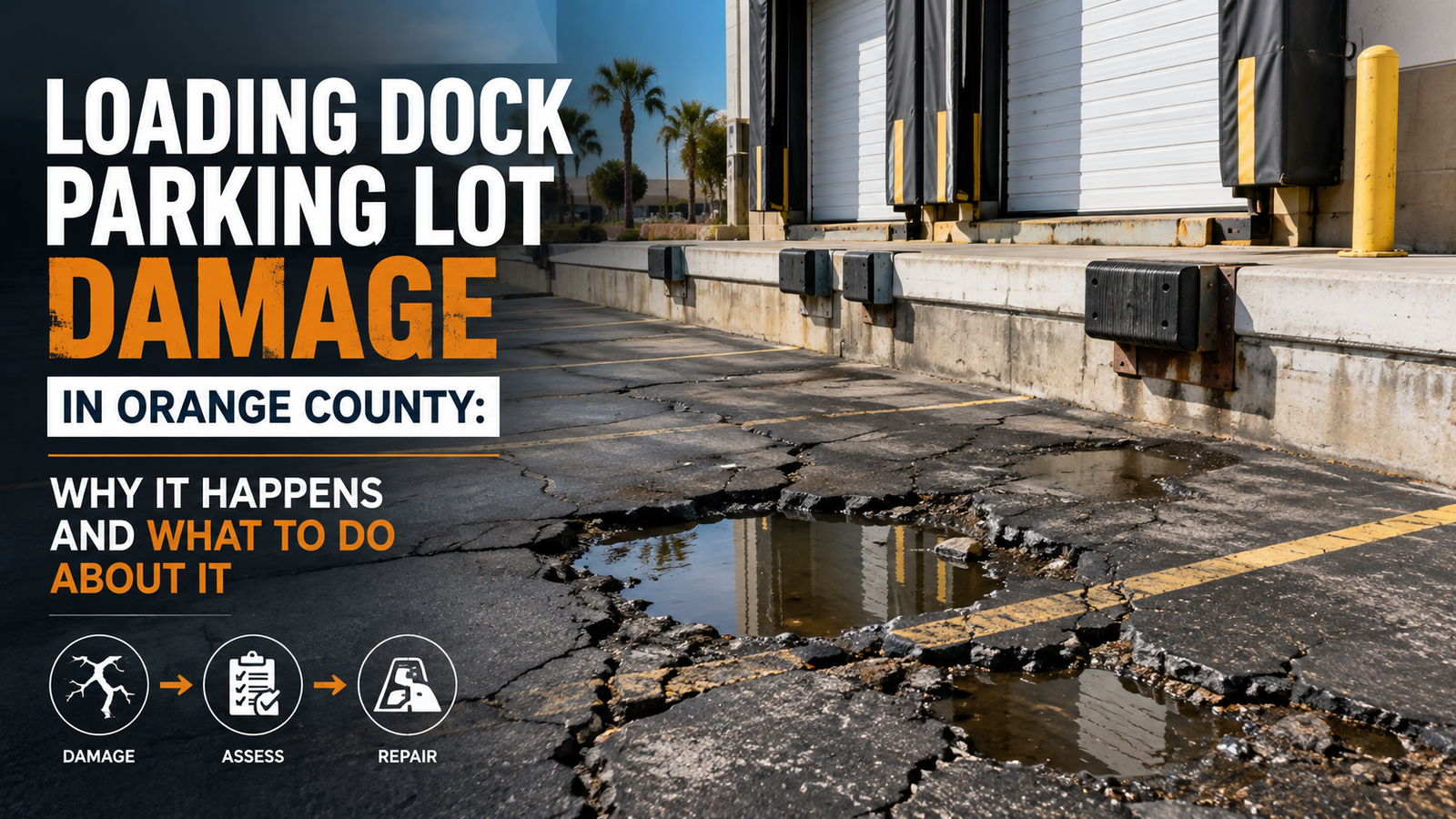
If you manage or own a commercial or industrial property in Orange County with loading dock facilities, you have almost certainly noticed that the pavement in and around the loading area fails faster, more severely, and more frequently than the pavement in the rest of your parking lot. This is not coincidence, and it is not simply a matter of bad luck or contractor quality. Loading Dock Parking Lot Damage Orange County areas are subjected to a specific combination of mechanical forces that make them among the most demanding pavement environments in the commercial property sector. Understanding why loading dock pavement fails so rapidly and what design and maintenance approaches mitigate this damage helps Orange County property owners manage their most maintenance-intensive pavement zones more effectively.
The Unique Pavement Stresses at Loading Docks
The fundamental challenge of loading dock pavement is that it experiences a combination of heavy loading, slow speeds, sharp turns, and static load periods that collectively create far more pavement stress than adjacent parking and drive lanes.
Semi-trailer static loading is the highest-magnitude stress event in loading dock pavement. When a trailer is parked at a dock for loading or unloading, its rear axles apply sustained, static loads to a fixed point on the pavement surface. A fully loaded tandem rear axle group can impose a total load of 34,000 pounds 17,000 pounds per axle to a specific, stationary pavement area for hours at a time. Static loading is actually more damaging to asphalt per unit of stress than rolling loading, because the pavement cannot recover between load applications. The result is rutting permanent vertical deformation in the precise footprint of the trailer axle positions.
Landing gear sinking and damage occurs when trailer landing gear (the mechanical support legs that hold the front of a trailer when disconnected from a tractor) is deployed onto the pavement surface. Landing gear concentrates very high loads onto four small pads the load bearing area is surprisingly small relative to the total load applied. This concentrated loading creates punching failure in the asphalt surface: a circular zone of depressed and cracked pavement immediately beneath each landing gear pad. This pattern of four symmetrically placed circular depressions is immediately recognizable to anyone familiar with loading dock pavement damage.
Turning stress from tractor maneuvers is another significant loading dock pavement stress. Tractors making tight turns to position trailers at dock doors apply high lateral shear forces to the pavement surface. The tractor’s drive axles, under high torque during the backing maneuver, push laterally against the asphalt surface with forces that cause the surface to shove to move horizontally in the direction of the applied force. Shoving appears as the characteristic surface “waves” or “washboarding” visible in heavy-use truck maneuvering zones.
Hydraulic oil, diesel fuel, and other petroleum spills are endemic to loading dock environments. Fuel spills during vehicle fueling, oil drips from tractor engine leaks, and hydraulic fluid releases from dock leveler systems all deposit petroleum products on the pavement surface. These petroleum products chemically dissolve the asphalt binder petroleum is chemically similar to the binder itself creating soft spots that deform under traffic and accelerate deterioration at the spill location.
Why Standard Parking Lot Pavement Fails at Loading Docks
A parking lot designed for passenger vehicles typically has a pavement section of 3 to 4 inches of asphalt over 6 to 8 inches of compacted aggregate base. This section is appropriate for the loads and traffic patterns of a standard passenger vehicle parking lot it can handle the repetitive loading of vehicles in the 2,000 to 6,000 pound range and the relatively simple loading of vehicles parking and departing.
When this same pavement section is used in a loading dock area, it is immediately inadequate for the task. The loads it encounters semi-trailer static loads of 34,000 pounds or more, landing gear concentrated loads, high-torque tractor drives exceed the design capacity of the pavement section by orders of magnitude. Failure is not a risk; it is a near certainty, and the only question is how quickly it will occur.
Many Orange County commercial and industrial properties were built with loading dock pavement that was designed (or not specifically designed at all) with the same section as the general parking lot. The result is the pattern visible throughout Orange County industrial parks: general parking lots that are serviceable, while the loading dock areas are severely rutted, potholed, and distressed after just a few years of operation. The loading dock pavement was never designed to handle what it is routinely asked to support.
Orange County’s Climate and Loading Dock Pavement Interactions
Orange County’s characteristic warm climate introduces additional complications for loading dock pavement. Asphalt softens at elevated temperatures at surface temperatures of 120 to 140°F (not unusual on a dark asphalt loading dock apron in direct Southern California summer sun), standard asphalt binder has significantly less stiffness than at normal ambient temperatures. Softened asphalt deforms much more readily under heavy static loading. The combination of high thermal softening (from Orange County’s sun) and extreme static loading (from semi-trailers parked at dock doors) creates the worst possible conditions for asphalt pavement performance.
Modified asphalt binders polymer-modified binders that maintain higher stiffness at elevated temperatures while retaining adequate low-temperature flexibility are the appropriate specification for loading dock areas in Southern California’s climate. Standard binder grades appropriate for general parking lots are not adequate for dock apron applications in the Orange County heat. Performance-graded (PG) binders selected for both the temperature extremes of the application and the heavy loading conditions provide meaningfully better rutting resistance than standard binder grades.
Proper Pavement Design for Orange County Loading Dock Areas
Loading dock pavement should be designed as a separate, higher-specification pavement structure from the general parking area. The design process begins with a structural analysis that accounts for the anticipated vehicle types, axle loads, and traffic volumes. For heavy industrial loading dock applications in Orange County, a typical design might call for 6 to 8 inches or more of high-quality asphalt over 12 to 18 inches of well-graded, properly compacted aggregate base.
The subgrade beneath the loading dock area should be evaluated by a geotechnical engineer to confirm its bearing capacity and to identify any conditions expansive clay, organic material, or poor drainage that would undermine the pavement structure. Loading dock areas that are located over problematic subgrade soils may require soil stabilization, installation of a geosynthetic reinforcement layer, or import of suitable fill material to create an adequate foundation.
Concrete is worth considering as a pavement material for the most heavily stressed loading dock zones. Portland cement concrete provides significantly better resistance to heavy static loading, rutting, and petroleum contamination than asphalt and has a longer service life in these extreme environments. Many Orange County industrial properties use concrete for the dock apron immediately at the dock door where the heaviest and most concentrated loading occurs and transition to asphalt for the truck maneuvering areas further from the dock. This hybrid approach takes advantage of concrete’s strength where it matters most while using the more economical and more easily maintained asphalt for the truck circulation areas.
Maintenance Approaches for Existing Loading Dock Pavement
For Orange County properties with existing loading dock pavement that is showing damage, the maintenance approach depends on the severity and type of damage present.
Mild rutting and surface deformation visible but less than 1 inch of vertical deformation can sometimes be addressed through surface milling and overlay with a high-performance, polymer-modified asphalt mix. The milling restores surface grade and removes the deformed material; the new overlay, if specified with appropriate binder grade, provides better rut resistance than the original surface. However, this approach is only appropriate when the deformation is limited to the surface layer and the base remains structurally sound.
Moderate to severe rutting with base distress requires full-depth repair or reconstruction. The failed pavement and compromised base material must be removed, the subgrade assessed and corrected if needed, new base installed and compacted to specification, and new asphalt placed with specifications appropriate for the loading conditions. This reconstruction should treat the loading dock zone as a separately designed structural section not simply duplicate the adjacent general parking lot section.
Pothole patching at loading docks requires the same full-depth approach described for driveway potholes clean vertical edge cuts, complete removal of failed material, base inspection and repair, proper compaction, and hot mix asphalt placement. Cold patch is entirely inadequate for loading dock potholes given the severity of loading and the vehicle types that transit the area. A cold patch in a loading dock apron will fail within weeks.
Petroleum contamination remediation is necessary when fuel or oil spills have penetrated the asphalt surface. The contaminated asphalt acts as a failed zone regardless of what is placed over it overlaying contaminated asphalt produces a weak bond and early failure. Contaminated asphalt must be removed and disposed of as a regulated waste material, and the underlying soil inspected for contamination before new pavement is placed. Drip pan installations at dock positions can prevent future contamination from vehicle leaks and spillage.
Petroleum Spill Management at Orange County Loading Docks
Petroleum products diesel fuel, motor oil, hydraulic fluid are an unavoidable presence at commercial loading dock areas. Tractors leak; fueling operations spill; hydraulic dock leveler systems release fluid. Each of these events deposits petroleum on the pavement surface, and each event damages the asphalt binder.
Prompt containment and cleanup of spills reduces the surface penetration and the extent of binder damage. Dry absorbent materials kitty litter, commercial oil absorbents, or dry sand should be applied to fresh spills immediately to prevent spreading and reduce penetration. Liquid spills that are allowed to stand on asphalt for hours will penetrate significantly deeper than those cleaned up within minutes.
Regular pressure washing of heavily contaminated loading dock surfaces removes petroleum accumulation before it can penetrate to the depth where structural damage begins. However, pressure washing also generates petroleum-contaminated runoff that must be managed in compliance with stormwater permit requirements Orange County’s MS4 permit requirements prohibit petroleum contaminated water from entering the storm drain system. An appropriate spill containment and wash water collection system may be required for high-volume loading dock washing operations.
Common Questions About Loading Dock Parking Lot Damage in Orange County
Why do my loading dock areas fail so much faster than the rest of my parking lot? The loading dock areas experience dramatically higher loads semi-trailers with 34,000-pound rear axle groups vs. passenger vehicles at 3,000 to 6,000 pounds and the specific damaging effects of static loading, landing gear concentrated loads, and tractor turning shear. If the dock areas were paved with the same specifications as the general lot, they are structurally inadequate for the loads they carry.
Should I use concrete or asphalt for my loading dock apron in Orange County? Concrete is generally superior for heavy loading dock applications in Orange County because of its resistance to rutting, static loading, and petroleum contamination. The higher upfront investment is often justified by the lower maintenance cost and longer service life. A hybrid approach concrete at the dock door zone transitioning to polymer-modified asphalt for truck maneuvering areas is a common and cost-effective configuration for Southern California industrial properties.
How can I prevent landing gear damage to my loading dock pavement? Steel or composite landing gear pads plates designed to distribute the landing gear load over a larger area are available and significantly reduce the concentrated pressure that creates punching failure. These pads are placed under each landing gear leg before deployment and prevent the concentrated point loading that damages asphalt. They are a modest investment that can meaningfully reduce the frequency of landing gear damage repairs.
What pavement specification should I use for a new or reconstructed loading dock area in Orange County? Loading dock pavement for heavy truck applications in Orange County should be designed by a pavement engineer based on the expected vehicle types and traffic volumes, using a performance-graded asphalt binder appropriate for both high-temperature rutting resistance and the South Coast climate. Typical heavy-use dock specifications in the region call for 6 to 8 inches of polymer-modified asphalt over 12 to 18 inches of compacted aggregate base roughly double the section used for a standard parking lot.